Buying guide
Five claims on a jar of Mānuka honey. Only one of them is a law.
MGO, UMF, monofloral, third party tested, traceable. What each one is actually backed by.
A jar of Mānuka honey costs many times what a jar of ordinary honey costs, and the reason is printed on the front in three or four characters. Ask ten people what that number measures and most will say strength. Ask what proves the honey inside the jar is Mānuka at all, and the room goes quiet.
That second question is the one worth learning, because the number on the front does not answer it. The two things are measured separately, by different tests, against different standards, and only one of them is written into law.
Manukora publishes the shortest version of this on its own blog, in a sentence that is worth more than most of the marketing written about this product:
Without testing, a label is just a claim. Manukora, Mānuka honey certifications guide
A well made jar of Mānuka honey carries five claims. Below they are taken one at a time, ordered by how hard each one is to fake, ending with the only claim you can check yourself while standing in your own kitchen.
The five claims, and who stands behind each one
The whole article in one card, if you are in a hurry.
Only claim 3 is written into a national standard, and it is the only one a brand cannot grade itself.
“MGO 850+” is a strength number, and it says nothing about the flower
MGO stands for methylglyoxal. It is a compound that forms in the nectar of the Mānuka tree and ends up in the honey, and the number on the jar is its tested concentration in milligrams per kilogram. MGO 600+ means the batch tested at 600 mg/kg or more. MGO 850+ means at least 850. There is no interpretation involved, which is exactly why it became the number everyone shops on.
Manukora is unusually careful about what that number is for. In its own guide: MGO should be understood as a strength marker, not a health claim. A higher number means more of one tested compound. It does not mean the honey is more authentic, better sourced, or better handled.
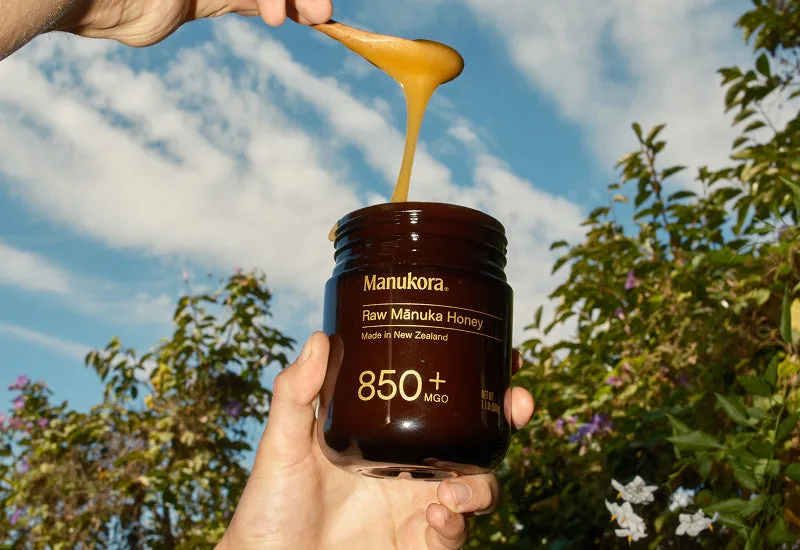
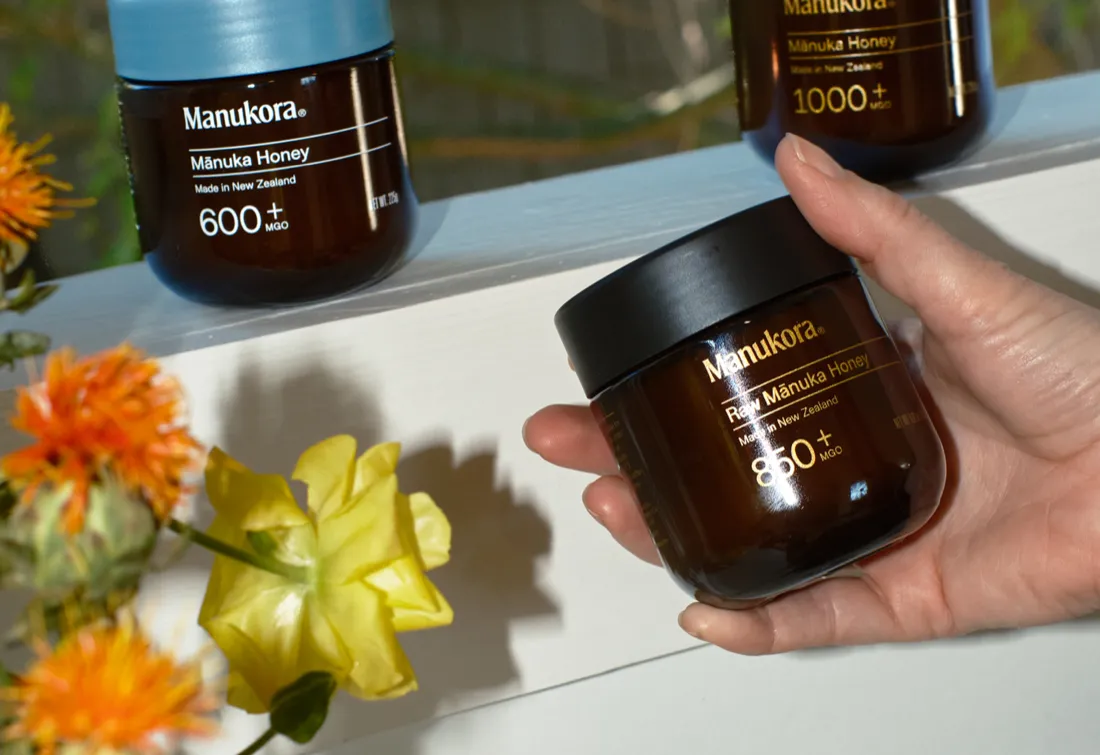
Here is the range as it is actually sold, with Manukora's own jar prices. The spread is worth looking at slowly, because the price does not climb in step with the number. It climbs faster.
Tested methylglyoxal, milligrams per kilogram
Manukora's standard grades, all in the same 8.82 oz jar. Bars are to scale.
Prices as listed on manukora.com on August 12, 2026, for the 8.82 oz (250 g) jar of each grade. Seven times the methylglyoxal, twelve times the price. Rare harvests are released separately, in smaller jars, above this range.
“UMF 20+” is three measurements wearing one number
UMF stands for Unique Mānuka Factor. Instead of reporting a single compound it rolls three markers into one grade: methylglyoxal, DHA (the precursor that slowly converts into methylglyoxal in the jar), and leptosperin, which Manukora describes in its own comparison as a natural marker that is hard to fake.
That last one is the point. Leptosperin comes from Mānuka nectar and does not appear if the honey has been cut with syrup or blended down, so a UMF grade carries an authenticity signal that a bare MGO number does not. The cost is legibility: because three things are folded together, you cannot read a UMF number back into a concentration.
The two systems are not rivals, and the same jar can hold both. Manukora publishes its own equivalence:
| MGO grade | UMF equivalent | How Manukora positions it |
|---|---|---|
| MGO 600+ | UMF 15+ | Everyday immune and general wellness support |
| MGO 850+ | UMF 20+ | Immune support plus healthy digestive function |
| MGO 1000+ | UMF 22+ | Healthy inflammatory response and overall wellness |
Equivalences and descriptions as published by Manukora. The brand puts MGO on the front of its jars because a single tested number is easier to compare between brands than a composite grade.
“Mānuka” is the only word on the jar that New Zealand defines by law
This is the part almost nobody knows, and it is the single most useful thing to carry into a shop.
New Zealand's Ministry for Primary Industries publishes a scientific definition of Mānuka honey. It is not a marketing standard and it is not optional. All honey labeled as Mānuka for export must be tested by a laboratory recognized by MPI against that definition before it leaves the country. Manukora refers to this on its own blog, noting that Mānuka honey is subject to extensive government testing before export and must meet the MPI definition.
The definition is five markers: four chemicals that come from the nectar, and one DNA marker that comes from Mānuka pollen. Every one of them has to clear a threshold.
The New Zealand government definition
Four chemical markers plus one DNA marker. Both grades below are legally Mānuka honey. Bars are to scale within each marker.
3-phenyllactic acid
The marker that separates the two grades, and the one that moves most.
Multifloral floor: 20 mg/kg, with a ceiling at 400.
2′-methoxyacetophenone
Multifloral floor: 1 mg/kg.
2-methoxybenzoic acid
4-hydroxyphenyllactic acid
Mānuka pollen DNA
A genetic test, not a chemical one. The pollen has to be there, and the assay has to find it below Cq 36, roughly 3 femtograms per microliter.
Markers and thresholds as published by the New Zealand Ministry for Primary Industries, Mānuka honey testing. Nothing in this definition mentions MGO.
Read that last line again, because it reverses the way most people shop. The government test that decides whether a jar may say Mānuka does not look at MGO at all. And the MGO number on the front does not tell you whether the honey cleared it.
The gap that opens up between the two legal grades is the practical part. Both jars below are Mānuka honey. Both may say so. One contains at least twenty times more of the marker that defines the category.
3-phenyllactic acid, the deciding marker
The legal floor for each grade. Both are sold as Mānuka honey.
Multifloral
20
mg/kg minimum
Bees worked Mānuka alongside a good deal of everything else in flower.
Monofloral
400
mg/kg minimum
Bees worked mainly Mānuka. This is the grade premium brands sell.
Manukora states that its MGO 850+ is 100% monofloral Mānuka honey certified to contain at least 850 mg/kg of methylglyoxal. Both halves of that sentence are separate tests, and a jar needs both to mean anything.
“Third party tested” answers the question “tested by whom”
Every claim so far rests on an assay, and an assay rests on whoever commissioned it. This is the quiet hinge of the whole category. A brand can test its own honey, in good faith, and publish a number that is entirely accurate. It can also do the opposite, and the label looks identical either way.
Manukora's own framing is the honest one, and it is worth stealing for any product you buy on a spec sheet:
Testing does not make the honey better by itself. It helps prove what is already inside the jar. Manukora, Mānuka honey certifications guide
Mānuka is a natural product, and Manukora makes the point itself: strength varies naturally from batch to batch, and one harvest produces a different level from the next. That variability is exactly why a per batch test matters more here than a brand promise. A grade is a floor the batch cleared, not a constant.
Alongside the strength assay, the certifications worth reading on a jar are the ones that name a body other than the brand:
Backed by a test or an audit
- Third party laboratory verification of the MGO level
- Test on the five Mānuka markers by an MPI recognized laboratory
- Glyphosate residue free, which is a residue assay
- Non-GMO verification
- B Corp certification, which audits the company rather than the honey
Backed by the brand saying so
- “Premium”, “wild”, “pure”, “authentic”
- “From the pristine forests of New Zealand”
- A gold seal designed in house
- A star rating with no count next to it
- A grading number with no lab named anywhere
Left column lists the certifications Manukora publishes for its own honey. Right column is generic category language, not a description of any particular brand.
“Traceable” is the only claim you can check yourself
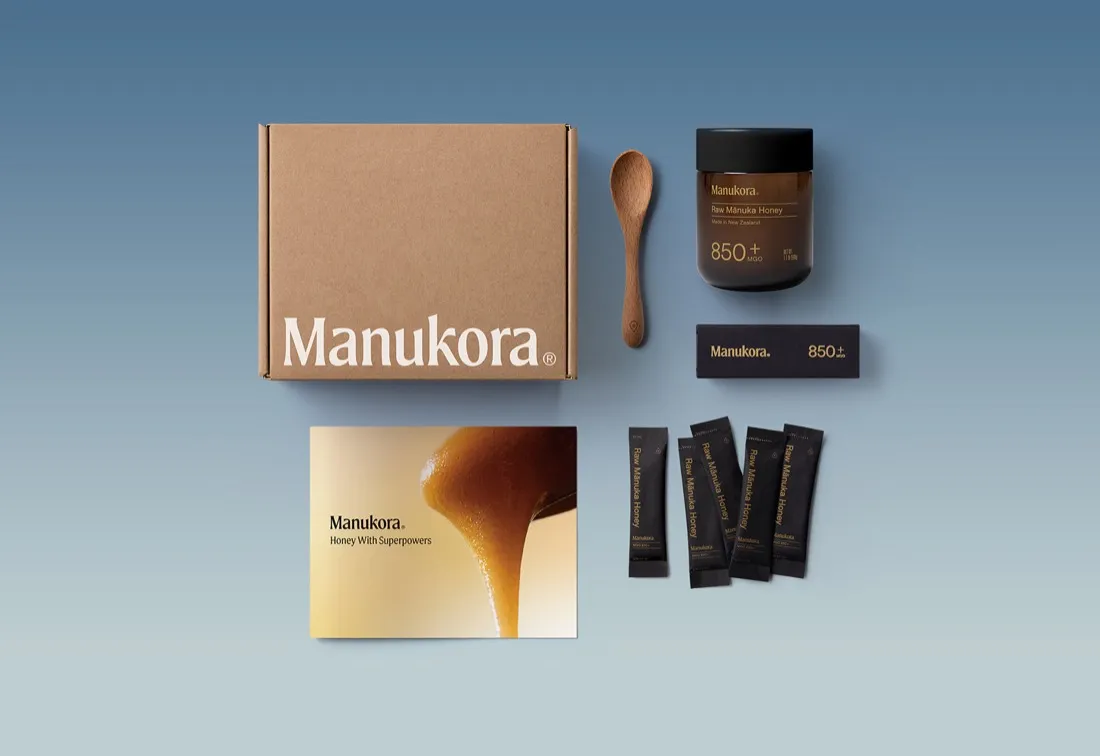
Everything above happens in a laboratory a long way from the shop. Traceability is different, and it is the reason the photograph at the top of this page is the one it is. A code on the packaging that resolves to a real batch turns the whole label from a set of assertions into something you can audit with a phone, in seconds, before you have even opened the jar.
Manukora describes the sequence in five steps.
What the code on the jar is supposed to open
Manukora's published traceability flow.
Steps as published by Manukora. The test of any traceability claim is step 3: whether the code returns data specific to your jar, or a brochure page identical for every jar ever made.
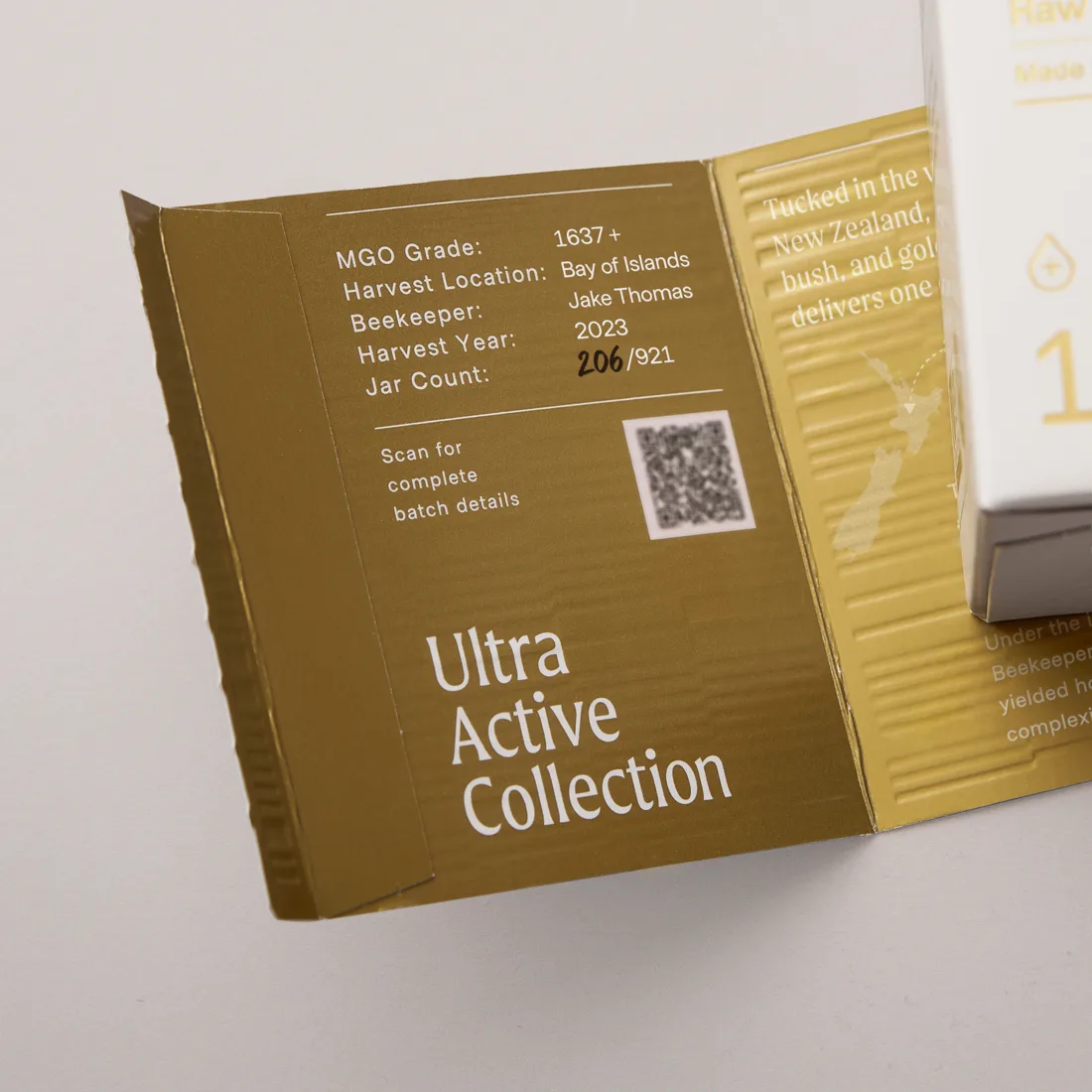
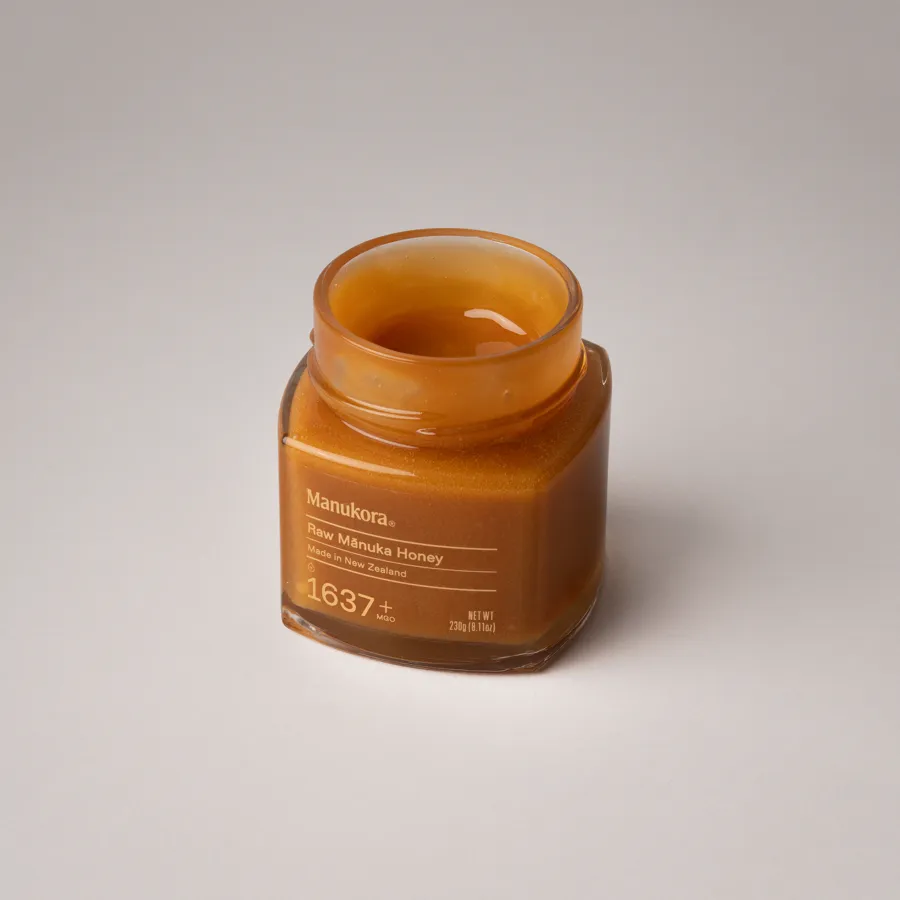
The box panel photographed at the top of this article is what that looks like when it is printed rather than scanned. Grade 1637+. Harvest location, Bay of Islands. Beekeeper, Jake Thomas. Harvest year, 2023. And the line that gives the game away as real record keeping rather than decoration: jar 206 of 921. Nine hundred and twenty one jars came out of that harvest, and the one photographed is the two hundred and sixth.
Why any of this exists: honey is the third most adulterated food in the world
None of these systems were built because the industry enjoys paperwork. They exist because honey has been diluted, blended and mislabeled for two thousand years, and because Mānuka, sitting at the top of the price list, is the most attractive target on the shelf.
Manukora's own history of the subject lists six methods in use today.
How honey gets faked
The six methods Manukora lists in its guide to honey authenticity standards.
Source: Manukora, how historical honey authenticity shapes today's standards. The same article notes that honey is the third most adulterated food in the world.
Read against that list, the five claims stop looking like marketing furniture. A per batch laboratory number defeats dilution. A leptosperin reading defeats blending down. A government marker panel defeats mislabeling. A named hive and a jar count defeat all three at once, because a fabricated supply chain is a great deal of work for a jar of honey.
The sixty second audit, for any jar of Mānuka honey
This is the whole article compressed into something you can run in a shop, on a website, or on the jar already in your cupboard.
Five things to check, in this order
- Does it say monofloral?This is the government grade and it is the one that decides whether the word Mānuka means much. If the jar only says Mānuka, look for the word multifloral nearby before you assume.
- Is there a number, and is it in mg/kg?MGO 600+, 850+, 1000+. A grade with no unit behind it is a brand's own scale, not a measurement.
- Who ran the test?Look for third party or independent laboratory, named. A brand that tests its own honey and says so is still ahead of a brand that says nothing.
- Is there a code, and does it return your batch?Scan it before you buy if you can. Batch level data is the pass. A generic brand page is the fail.
- Does the price make sense for the grade?High MGO is genuinely scarce, so it is genuinely expensive. A very high number at a very low price is the one combination that cannot be explained by good sourcing.
How one brand answers the five questions
Manukora is used throughout this article because it publishes enough detail to be checked, which is not universal. Here is its own answer to each of the five claims, taken from its product pages and its guides.
| Claim | What Manukora publishes |
|---|---|
| Strength | MGO printed on the front, from 200+ to 1400+ in the standard range, with rarer single harvest releases above it. The hero grade, MGO 850+, is stated as certified to contain at least 850 mg/kg of methylglyoxal. |
| Grading system | MGO on the label, with a published UMF equivalence: 600+ maps to UMF 15+, 850+ to UMF 20+, 1000+ to UMF 22+. |
| Floral source | 100% monofloral Mānuka, harvested in New Zealand from Leptospermum scoparium, in regions including Northland, East Cape, Wanganui and Taranaki. |
| Testing | Third party tested for purity and potency, glyphosate residue free, Non-GMO verified, B Corp certified. |
| Traceability | A code on every jar returning batch MGO, region and beekeeper. Batch panels are printed with the harvest year and the jar count. |
All of the above is reproduced from manukora.com as published on August 12, 2026. The brand lists 2015 as its founding year and gives an address in Te Aroha, New Zealand.
What buyers say once they have stopped comparing labels
Manukora publishes more than 25,000 verified five star reviews across its range. The MGO 850+ jar alone carries 17,056 reviews at an average of 4.88. A handful of what they say, as published on the brand's own site:
This is the best honey in the entire world. If you care about your immune health, this is a must. I enjoy it every morning.
Mel
I can feel the difference, more energy and a better mood.
Debbie R.
I take it religiously every single day.
Heidi D.
It really is better. Simple as that.
Candice C.
Reviews as displayed on manukora.com. Star ratings and counts as shown on the brand's product navigation on August 12, 2026.
Which grade, if you are buying one
The honest answer, and Manukora says this itself, is that the grade you will actually finish beats the grade that impresses you in the shop. Chasing the highest number is the most common way to spend a lot and use it twice.
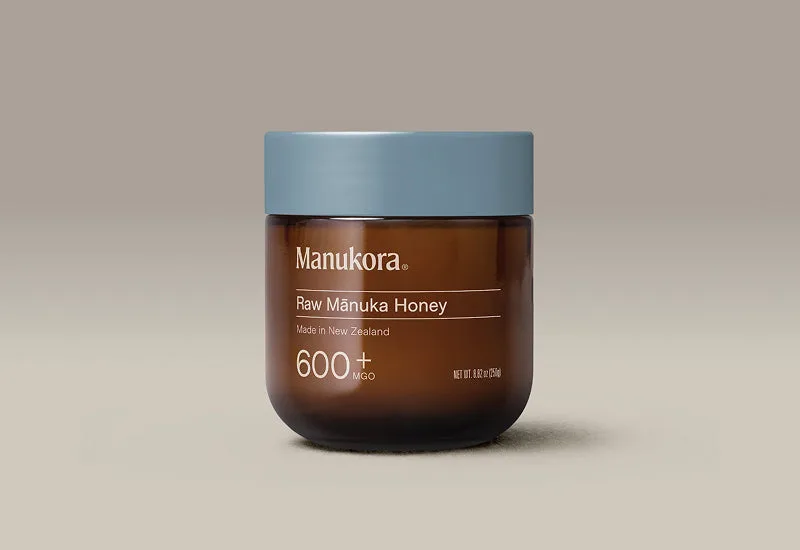 MGO 600+
UMF 15+ equivalent. The starting grade for a daily habit. 4.9 stars from 1,799 reviews.
$55 a jar · See it
MGO 600+
UMF 15+ equivalent. The starting grade for a daily habit. 4.9 stars from 1,799 reviews.
$55 a jar · See it
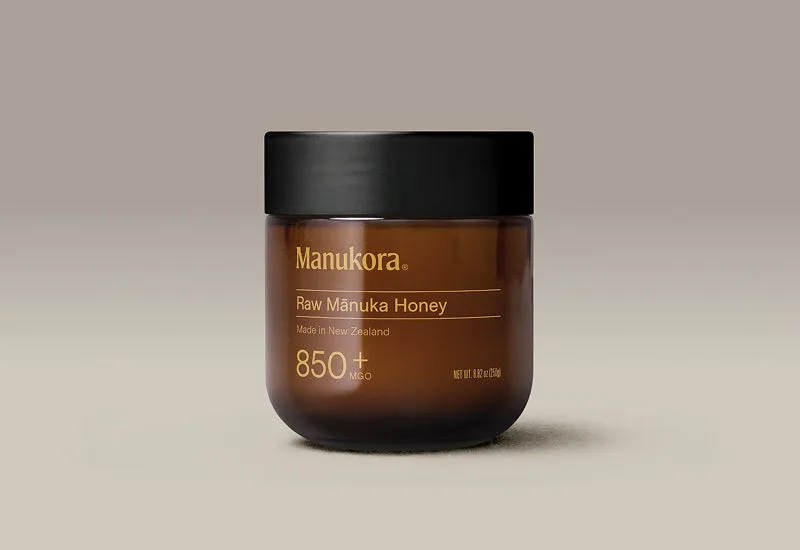 MGO 850+
UMF 20+ equivalent. The best seller, and the grade the brand calls its hero. 4.88 stars from 17,056 reviews.
$80 a jar · See it
MGO 850+
UMF 20+ equivalent. The best seller, and the grade the brand calls its hero. 4.88 stars from 17,056 reviews.
$80 a jar · See it
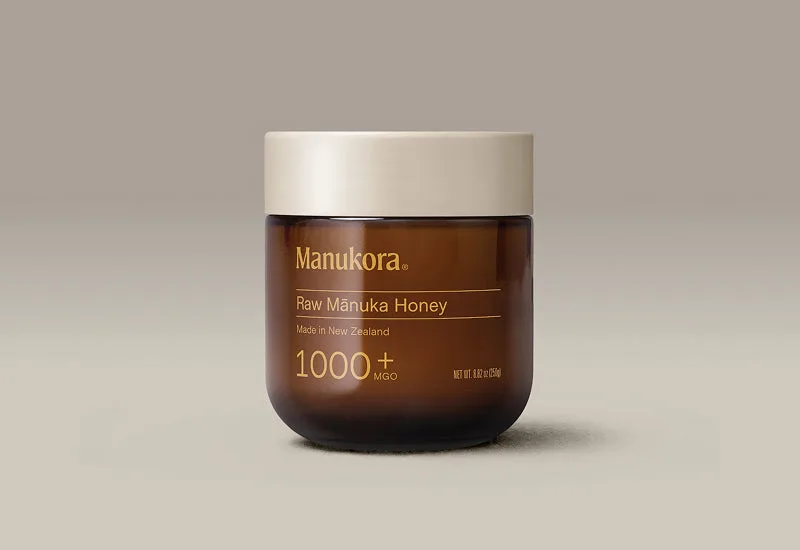 MGO 1000+
UMF 22+ equivalent. Higher strength, for a routine that is already established. 4.87 stars from 2,788 reviews.
$120 a jar · See it
MGO 1000+
UMF 22+ equivalent. Higher strength, for a routine that is already established. 4.87 stars from 2,788 reviews.
$120 a jar · See it
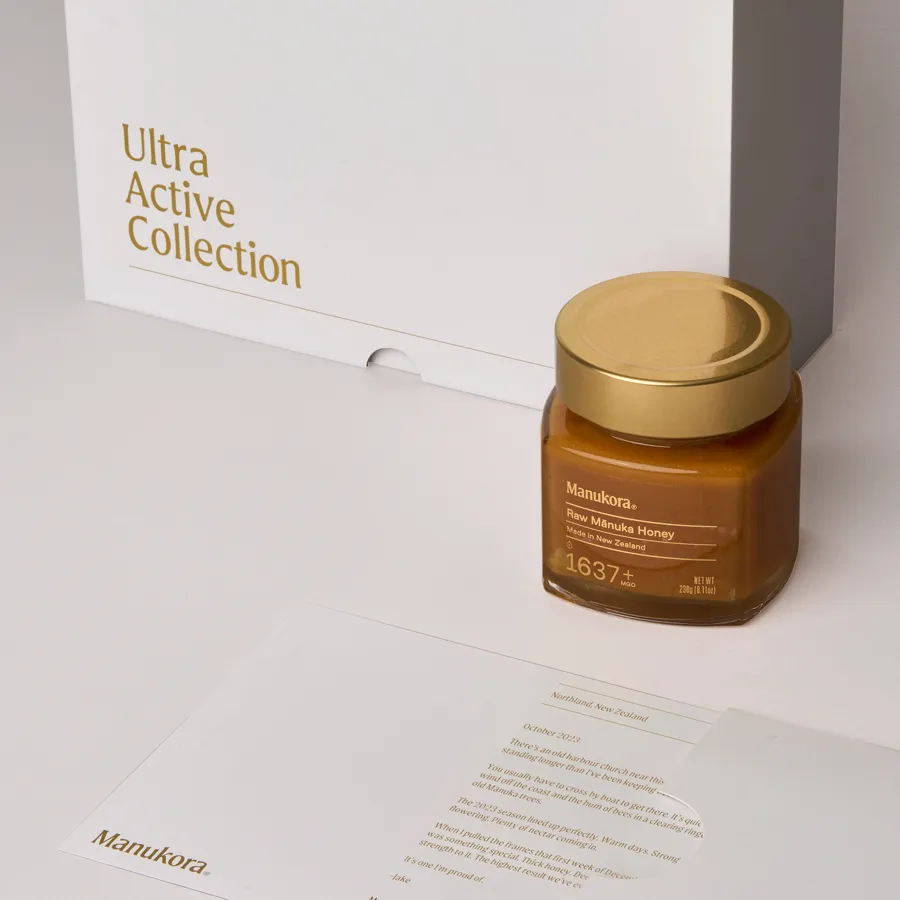 Secret Spot Harvest, MGO 1637+
The batch photographed at the top of this page. Individually numbered jars from one harvest.
$350 for the 230 g limited edition · See it
Secret Spot Harvest, MGO 1637+
The batch photographed at the top of this page. Individually numbered jars from one harvest.
$350 for the 230 g limited edition · See it
Questions people ask before they buy
Is a higher MGO number always better?
No. Manukora says so plainly in its own guide: the right level depends on your routine and on consistency, not on picking the highest number on the shelf. A strength you reach for daily does more than a premium jar gathering dust.
Does the MGO number tell me the honey is real Mānuka?
No, and this is the most common confusion in the category. MGO measures one compound. Whether the honey qualifies as Mānuka, and whether it is monofloral or multifloral, is decided by a separate five marker test that does not look at MGO.
Should I look for MGO or UMF?
Either, and both are valid. MGO is a direct concentration you can compare in seconds. UMF folds in leptosperin, which is hard to fake, so it carries an extra authenticity signal at the cost of being harder to read.
Why is Mānuka honey so expensive?
The tree flowers for a short window, yields swing year to year, and the best sites are remote. On top of the sourcing sit the tests, the traceability and the quality checks that make the label mean something. Higher grades are scarcer, so they cost more.
Can I stir it into hot tea?
Let the water come off the boil first. Manukora's own guidance is to take it straight from the spoon, or to stir it into a drink that is warm rather than boiling, and ideally on an empty stomach in the morning.
How long does a jar last?
A 250g jar is roughly 18 heaped teaspoons, so about two and a half weeks at one a day. The 500g jar is roughly 35.
The short version
The number on the front of the jar is a strength measurement and nothing more. The word that decides whether you are holding Mānuka honey at all is monofloral, it is defined by the New Zealand government across five markers, and every jar exported from the country has to clear it in a laboratory the brand does not own. Third party testing tells you who ran the numbers. And a code that opens your actual batch, with a region and a beekeeper behind it, is the only claim on the jar you can verify yourself.
Check those five things and the price stops being mysterious. You are not paying for honey. You are paying for the part of the jar that can be proved.
See the MGO 850+ jar 100% monofloral · third party tested · traceable to the hive · 4.88 stars from 17,056 reviews